Pharmaceutical From Standard to Specialist Capsule Formats Hard gelatin, HPMC, inhalation and vaginal formats engineered for every therapeutic need.
Nutraceutical Consumer-Ready Nutraceutical Formats Capsules and branded ingredients built for supplement manufacturers who demand differentiation.
Pharmaceutical CDMO
Accelerating Drug Development
Our Innovaform Accelerator and Tampa facility combine formulation science with scalable manufacturing.
CDMO Partnership
Full-Service Nutraceutical Manufacturing
From concept to market-ready product — your end-to-end nutraceutical development partner.
Our Story
Partners in Drug Delivery Innovation
A global leader in capsule technologies, committed to advancing pharmaceutical and nutraceutical science.
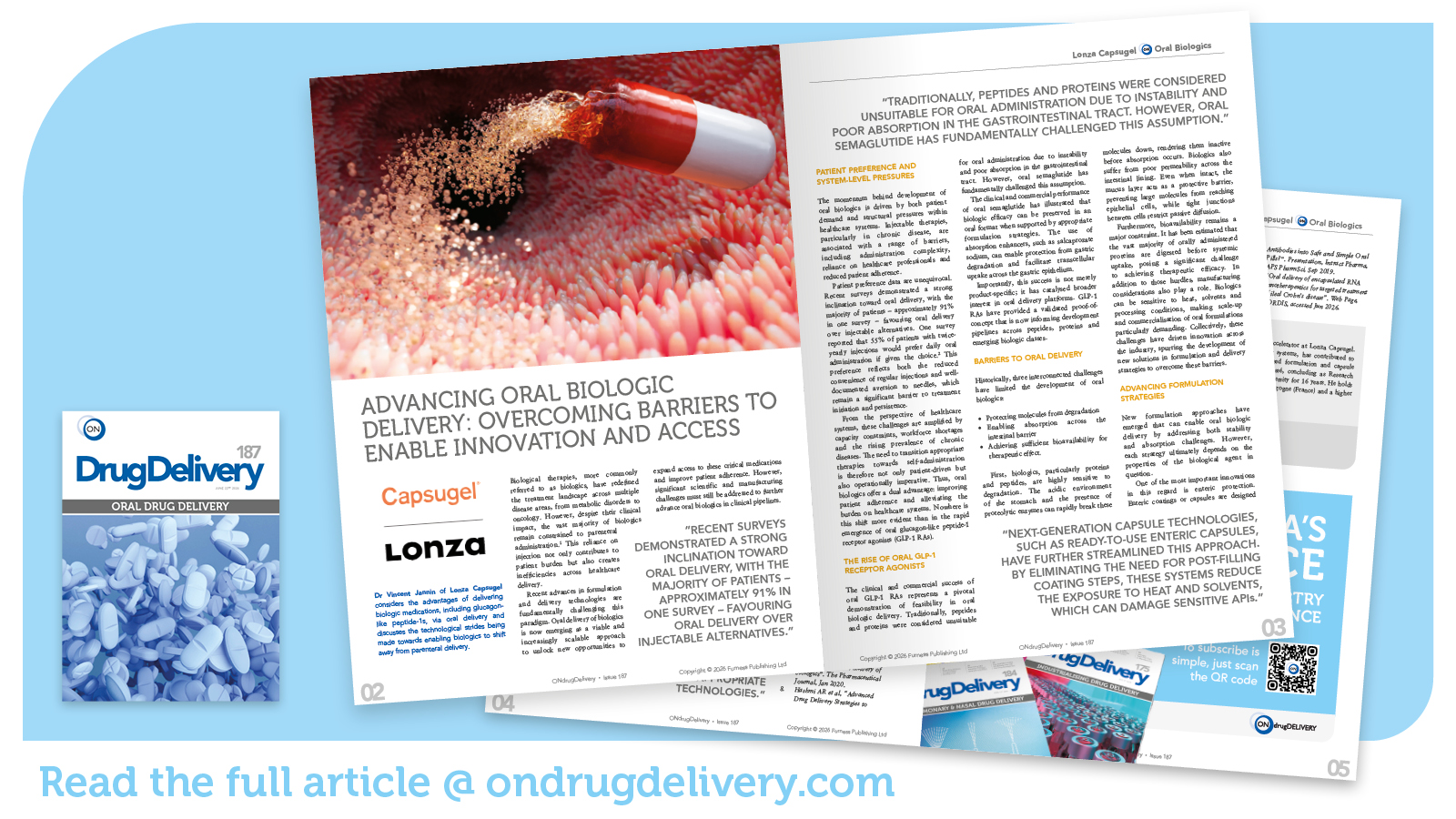
Oral delivery of glucagon-like peptide-1 (GLP-1) peptides has the potential to improve patient convenience and adherence, but gastrointestinal degradation and limited intestinal absorption remain significant challenges.
In this newly published study, researchers at Lonza Capsugel developed and evaluated a proof-of-concept oral delivery platform combining hydrophobic ion pairing (HIP), lipid-based formulation (LBF), and enteric capsule technology.
The work focused on developing a lipid-based formulation of the model GLP-1 analog exenatide using HIP chemistry and permeation enhancers to support intestinal absorption, while also evaluating the performance of Capsugel® Enprotect® capsules and engineering a customized enteric capsule bi-layer system for gastro-protection and targeted intestinal delivery.
Overall, the study demonstrates a promising approach for enhancing the in vitro enzymatic protection of peptide therapeutics and lays the groundwork for future in vivo evaluations of bioavailability and therapeutic efficacy.
Access the full publication to explore how lipid-based formulations and enteric capsule technology can work together to enhance in vitro peptide protection and support the future development of oral GLP-1 therapies.
Reference:
1. Dumont C, Gonzalez V, Klatt P, Picco S, Nombret D, Agisson M, Uku E, Saurel T, Jannin V. A two-tier protection strategy for oral delivery of GLP-1 peptides: lipid-based formulation combined with enteric capsules. Frontiers in Drug Delivery. 2026; 6:1770094. doi:10.3389/fddev.2026.1770094. https://doi.org/10.3389/fddev.2026.1770094
Downloads
Latest CHI content