Pharmaceutical From Standard to Specialist Capsule Formats Hard gelatin, HPMC, inhalation and vaginal formats engineered for every therapeutic need.
Nutraceutical Consumer-Ready Nutraceutical Formats Capsules and branded ingredients built for supplement manufacturers who demand differentiation.
Pharmaceutical CDMO
Accelerating Drug Development
Our Innovaform Accelerator and Tampa facility combine formulation science with scalable manufacturing.
CDMO Partnership
Full-Service Nutraceutical Manufacturing
From concept to market-ready product — your end-to-end nutraceutical development partner.
Our Story
Partners in Drug Delivery Innovation
A global leader in capsule technologies, committed to advancing pharmaceutical and nutraceutical science.
Introduction
Healthcare systems are facing increasing pressure as record demand, an aging population, the burden of chronic disease, and economic inflation challenge clinics, hospitals, and healthcare professionals to adequately keep up.1,2 Workforce supply shortages and tight healthcare budgets, especially since COVID-19, contribute to significant capacity issues across the healthcare system, e.g. poor access to appointments across primary and secondary care and discharge delays.2
Hospital- or clinic-based therapies can also present further barriers to access on a patient level, with some especially prominent in older patients. For example, needle phobia has long been recognized as a deterrent to key medical procedures (e.g. blood draws, vaccinations) or initiation of injectable therapies and was reported by over 60% of adults in a large international survey from 2022.3 Geographical constraints (including distance, location, transport, and digital access) disproportionately affect patients with poor time flexibility, financial barriers, and limited mobility or access to transportation; the latter factors represent some of the key challenges for the ageing population.1,4
When these barriers are considered in the context of poor healthcare capacity, transitioning patients toward self-administered dosage forms may offer a compelling pathway to relieve resource strain while expanding access to therapy.
Innovation in oral formulations
The drive for oral or needle-free versions of traditionally injectable therapies additionally reflects a shift towards patient-centered care—a large survey of adults taking injectable therapies for chronic conditions showed a clear preference for an oral option, even if the dosing frequency was higher than with the parenteral route.5
Historically, oral delivery of biologics and other complex molecules has been viewed as infeasible due to the inherent nature of the gastric environment, e.g. acidic conditions lead to loss of therapeutic activity, the presence of proteolytic enzymes prompts degradation of amino acid-based APIs, and the stomach and intestinal barriers are poorly permeable to large molecules.6,7
However, recent advances in formulation science are reshaping this perception. Innovations such as enteric protection, lipid-based formulations (LBFs), hydrophobic ion pairs (HIPs), and permeation enhancers are increasingly enabling oral delivery approaches for peptides and other acid-sensitive therapies.6–8
Capsugel is committed to supporting oral biologic delivery
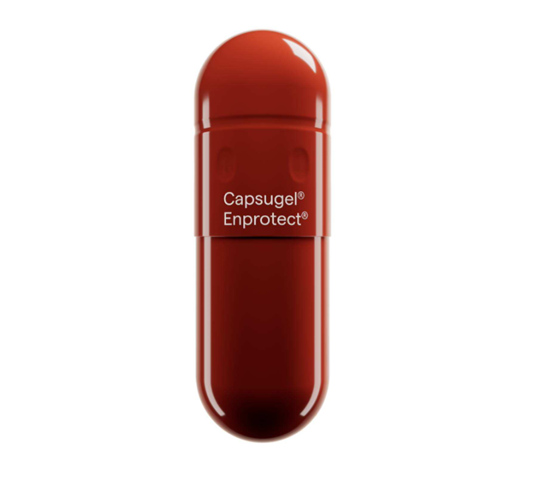
Capsugel has developed a next-generation, scalable delivery solution. Their bi-layered Capsugel® Enprotect® capsules are designed to protect acid-sensitive APIs and allow targeted enteric delivery without the need for a post-filling coating step.6,7 Capsugel® Enprotect® capsules are highly customizable and compatible with various polymers and formulations designed to enhance bioavailability and permeability of APIs.8
Capsugel® Enprotect® capsules have demonstrated robust gastro-resistant performance and adaptability to storage conditions across a range of demanding applications:
- Testing in an advanced ex vivo model confirmed that Capsugel® Enprotect® capsules enabled targeted delivery of pancrelipase to the jejunum without the need for a complex formulation9
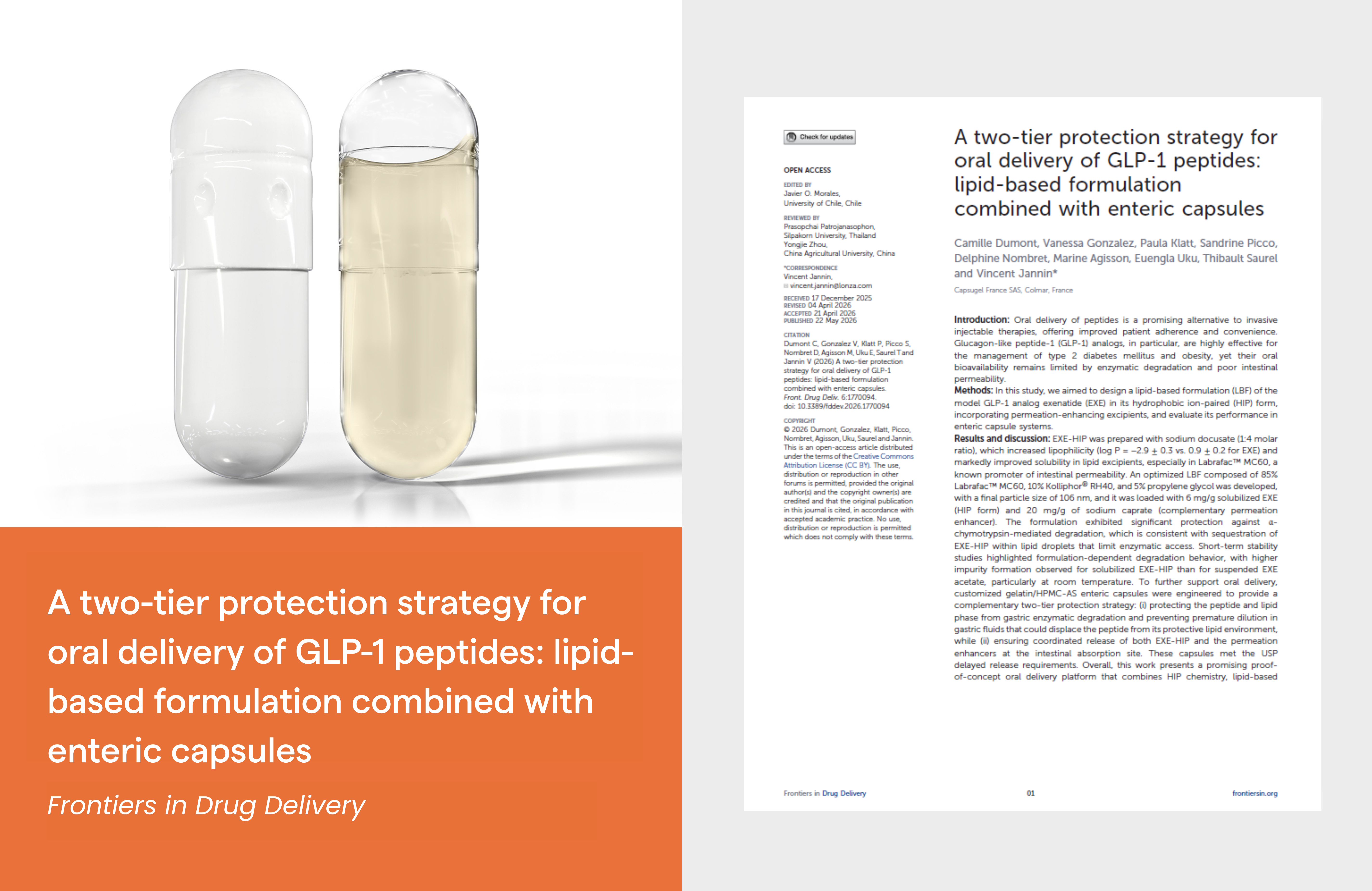
- A successful oral version of the glucagon-like peptide 1 receptor agonist (GLP-1 RA) exenatide (EXE) was developed by combining an LBF, created by forming HIPs with EXE using sodium docusate and adding the permeation enhancer sodium caprate, with customized Capsugel® Enprotect® gelatin/hydroxypropyl methylcellulose acetate succinate (HPMC-AS) capsules to enable enteric delivery and avoid EXE degradation in the upper gastrointestinal tract7,8
- Capsugel® Enprotect® capsules were determined to be stable and compatible with standard fecal microbiota transplant placebo formulation upon storage at −80°C for at least 12 months and for a thawing time of 30 minutes to 6 hours. Therefore, they offer a solution to address the current requirement of double encapsulation, which could save cost and expand access for pediatric use10
Transition to oral biologic delivery could reduce financial burden
Beyond patient convenience, switching from injectable to oral delivery offers important health-economic advantages. A budget impact analysis conducted at Johns Hopkins demonstrated that switching clinically eligible patients from intravenous to oral therapies resulted in substantial cost savings from medication cost alone, with additional savings possible if costs associated with injectable administration and hospitalization were considered.11 Cost-effectiveness modeling in the UK evaluating the diabetes market has similarly demonstrated that oral semaglutide is cost-effective and improved quality of life compared with tested injectable GLP-1 RA options.12,13
Conclusion
As healthcare systems remain under pressure1,2 and continue to seek sustainable, patient-centered models of care, oral delivery of complex biologics represents a significant opportunity. Advances in formulation science,7,8 development of proven, scalable delivery methods,7–10 and growing economic evidence11–13 justify continued investment into this area.
Capsugel are committed to advancing the capabilities of oral drug delivery, with already established success stories with oral GLP-1 RAs.7,8 Our Innovaform® Accelerator provides bespoke solutions for formulation development, capsule innovation, and process optimization as a trusted partner for any product.
Innovaform® Accelerator is Capsugel’s innovation center for novel drug delivery systems—our scientists support clients to develop bespoke formulation strategies for every step of a product’s lifecycle, working to advance the capabilities of oral dosage delivery.
To learn more or discuss how Lonza Capsugel can advance your next Oral Biologics | Capsugel formulation, contact us today Contact Us | Lonza
References
- Khan HTA, et al. Public health challenges and responses to the growing ageing populations. Public Health Chall. 2024;3(3):e213.
- Powell T, et al. Capacity pressures in health and social care in England. 2024. Available at: https://commonslibrary.parliament.uk/capacity-pressures-in-health-and-social-care-in-england/. Accessed May 2026.
- Alsbrooks K and Hoerauf K. Prevalence, causes, impacts, and management of needle phobia: An international survey of a general adult population. PLOS One. 2022;17(11):e0276814.
- Haven A. How to overcome geographical barriers in health and social care. 2024. Available at: https://uk.hfonline.org/how-to-overcome-geographical-barriers-in-health-and-social-care/. Accessed May 2026.
- Myers JT, et al. Preference for a novel oral alternative to parenterally administered medications. Patient Prefer Adherence. 2024;18:1547–1562.
- Grimm M, et al. In vivo evaluation of a gastro-resistant Enprotect® capsule under postprandial conditions. Pharmaceutics. 2023;15(11):2576.
- Dumont C, et al. Improving oral bioavailability of therapeutics peptides with lipid-based formulations and ready-to-use customized enteric capsules. AAPS PharmSci 360 Annual Meeting. 9–12 November 2025, San Antonio, TX. Poster M1230-06-38.
- Jannin V, et al. Lipid formulations in customized enteric capsules show promising results for oral GLP-1 RA delivery. CRS Annual Meeting & Exposition. 13–18 July 2025, Philadelphia, PA. Oral Presentation.
- Jannin V, et al. In vitro evaluation of the gastrointestinal delivery of acid-sensitive pancrelipase in a next generation enteric capsule using an exocrine pancreatic insufficiency disease model. Int J Pharm. 2023:630:122441.
- Jannin V, et al. Enteric properties of Capsugel® Enprotect® capsules filled with Fecal Microbiota Transplant are confirmed after 12-month storage at -80°C. ECP 2025. 24–25 March 2025, Porto, Portugal. Poster Presentation.
- Lau BD, et al. Budget impact analysis of conversion from intravenous to oral medication when clinically eligible for oral intake. Clin Ther. 2011;33:1792–1796.
- Chubb B, et al. PDB25 The cost-effectiveness of oral semaglutide in patients treated with currently available GLP-1 receptor agonists - A UK perspective. Value in Health. 2020;23(S2):S509.
- Elnaggar M, et al. The long-term cost-effectiveness of oral semaglutide versus lower-cost liraglutide in the UK. Diabetes Ther. 2025;16(4):613–628.
Related Content:
Latest CHI content