Pharmaceutical From Standard to Specialist Capsule Formats Hard gelatin, HPMC, inhalation and vaginal formats engineered for every therapeutic need.
Nutraceutical Consumer-Ready Nutraceutical Formats Capsules and branded ingredients built for supplement manufacturers who demand differentiation.
Pharmaceutical CDMO
Accelerating Drug Development
Our Innovaform Accelerator and Tampa facility combine formulation science with scalable manufacturing.
CDMO Partnership
Full-Service Nutraceutical Manufacturing
From concept to market-ready product — your end-to-end nutraceutical development partner.
Our Story
Partners in Drug Delivery Innovation
A global leader in capsule technologies, committed to advancing pharmaceutical and nutraceutical science.
The exclusivity period and subsequent loss of exclusivity (LOE) are critical points in the lifecycle of any drug, particularly for biological therapies facing competition from biosimilars. For the healthcare industry, LOE is a vital way to regulate healthcare costs by increasing competition, saving trillions over the long term and increasing accessibility for patients.1,2 However, for the pharmaceutical company it represents a steep drop in revenue and the end of a vital commercial period used to recoup development costs and potentially fund future research.2,3 With the stakes so high and development costs rising, strategies to extend exclusivity have become an essential part of successful lifecycle management for pharmaceutical companies.2,4 These strategies range from significant clinical innovations and breakthroughs to heavily criticized and legally contested tactics.2
In this article, we discuss the different strategies that can be used to extend exclusivity and how innovation in oral biologic formulation is opening new opportunities for the patent protection of biologics, with the potential to benefit patients, the wider healthcare system, and pharmaceutical companies.
What is the difference between patent expiration and loss of exclusivity?
To understand exclusivity periods and extensions, an understanding of the different types of patent protections is needed.5
- Compound patents: protect the chemical structure of the active molecule
- Formulation patents: protect how the drug is delivered, for example extended-release coated capsules, etc.
- Process patents: protect manufacturing methods
- Method-of-use patents: protect specific therapeutic indications
- Dosing regimen patents: protect specific administration schedules
- Metabolite and active moiety patents: protect the biologically active form of a drug that has been processed by the body from a prodrug
Pharmaceutical patents are narrow and specific; typically drugs are protected by multiple patents with different
expiration periods.5 The compound patent is typically the foundational patent—the first to be filed and the first to expire.5 The TRIPS Agreement administered by the World Trade Organization standardized at 20 years of exclusivity from time of filing. While this sounds like a substantial commercial period, in reality pre-clinical work often takes up more than half of the time.2 Biologics, in particular, are known to have long development timelines and face additional regulatory scrutiny, which substantially reduces the commercially viable time of the patent term.2
To balance long development times and incentivize innovation, there are region-specific ways to extend the exclusivity period beyond the patent; as a result, the exclusivity period can expire after the core patent and vary by region.2 In the EU, the mechanism to extend exclusivity is the Supplementary Protection Certificate (SPC).2 This extends exclusivity of a specific product authorization by up to 5 years, with an additional 6-month extension if pediatric studies are completed and a cap of 15 years from the date of first authorization.2,3 In the US, the extension mechanism is through Patent Term Restoration outlined in the Hatch-Waxman Act.2,3 Like in the EU, the maximum extension period is 5 years, with an additional 6-month extension for pediatric studies, but the total increase is capped, so post-approval exclusivity does not exceed 14 years.2,3
Patent strategy often includes setting up additional patents for reformulations of modifications to a therapy; these can cover changes to the active compound, formulation modifications, specific dosing regimens, or alternative delivery devices.2,5 The practice has been heavily criticized in instances where the change is considered to offer little benefit vs the original and comes with a significant legal risk, particularly when the original product is pulled from the market (dubbed “product hopping”, “evergreening”, or “forced switching”).1,2 However, it should be noted that these same patents can be used to protect genuine clinical innovations benefiting the patient, which we will explore in the next section.
What can we learn about lifecycle management from oral GLP-1 receptor agonists (RAs)?
Novo Nordisk’s management of semaglutide provides a perfect example of how the intersection of formulation innovation and patent protection can benefit patients, the healthcare system, and the pharmaceutical company.6–8 Novo Nordisk’s blockbuster semaglutide, marketed as Ozempic®, Wegovy® and Rybelsus®, is a peptide that works as a GLP-1 RA. While the brand names Ozempic® and Wegovy® are now household names, the less well-known Rybelsus® represents a significant breakthrough for biologic delivery.9 Historically, biological therapies have been delivered via injection, as proteins and peptides are susceptible to degradation by gastric enzymes and have low oral bioavailability.9 Rybelsus® overcame this barrier by formulation with sodium N-(8-[2-hydroxybenzoyl]amino)caprylate (SNAC), which acts as a local buffer, protecting semaglutide from the conditions in the stomach, allowing it to be absorbed.9
The benefits for patients are clear—the majority of patients prefer oral delivery over injections.9–11 ~90% of type 2 diabetes mellitus patients in a Japanese study preferred oral semaglutide over any tested injectable GLP-1 RA comparator.11 For Novo Nordisk this innovation means fresh exclusivity protections for the oral formulation. While the original core compound patent expired in 2026, the patents relating to Rybelsus® extend to 2034 and 2039.6 Rybelsus® generated a revenue of USD 3,281.9 million in 2024, with this predicated to reach USD 12,662.5 million by 2035.12 The benefits of oral formulations even extend to the wider healthcare system, with the potential to reduce staff workload, healthcare costs, and the waste associated with sharps.13,14 In the case of Rybelsus®, two UK-based studies have investigated the potential health-economic benefits vs injectable alternatives.7,8 The first compared against the currently prescribed GLP-1 RAs and predicted savings of £251 and an increase of 0.03 quality-adjusted life years (QALY) per patient.7 The second compared against liraglutide specifically, which has low acquisition costs in the UK due to expiration of the patent.8 This study predicted a 0.18 QALY improvement with Rybelsus® due to a reduced incidence of diabetes-related complications and a reduced administration burden.8 They also predicted reduced complication costs per patient with Rybelsus® vs liraglutide of £187, concluding that the oral formulation was either dominant or cost effective in the majority of scenarios, even compared with liraglutide price reductions of 50%.8
What is the future for oral biologics?
With the commercial potential for oral biologics now demonstrated in the market, there has been a renewed interest in the development of future oral therapies. SNAC and other innovative technologies are overcoming the barriers of poor stability and permeability associated with large molecules in the gastrointestinal tract environment, signalling the beginning of a new era.7,15
For example, Capsugel® Enprotect® capsules are ready-to-use enteric capsules designed to protect APIs from the harsh conditions of the stomach.16 Unlike traditional coated capsules, these capsules do not require post-filling coating, protecting sensitive APIs from exposure to heat and solvents in this step.16 Two studies have demonstrated the potential for Capsugel® Enprotect® capsules to deliver biologic therapies to the intestine without the need for special formulations.17,18 The first used an advanced ex vivo model to demonstrate delivery of pancrelipase as a treatment for patients with exocrine pancreatic insufficiency.17 The second study confirmed the potential to deliver fecal microbiota transplantation, an established treatment for Clostridium difficile infections.18,19
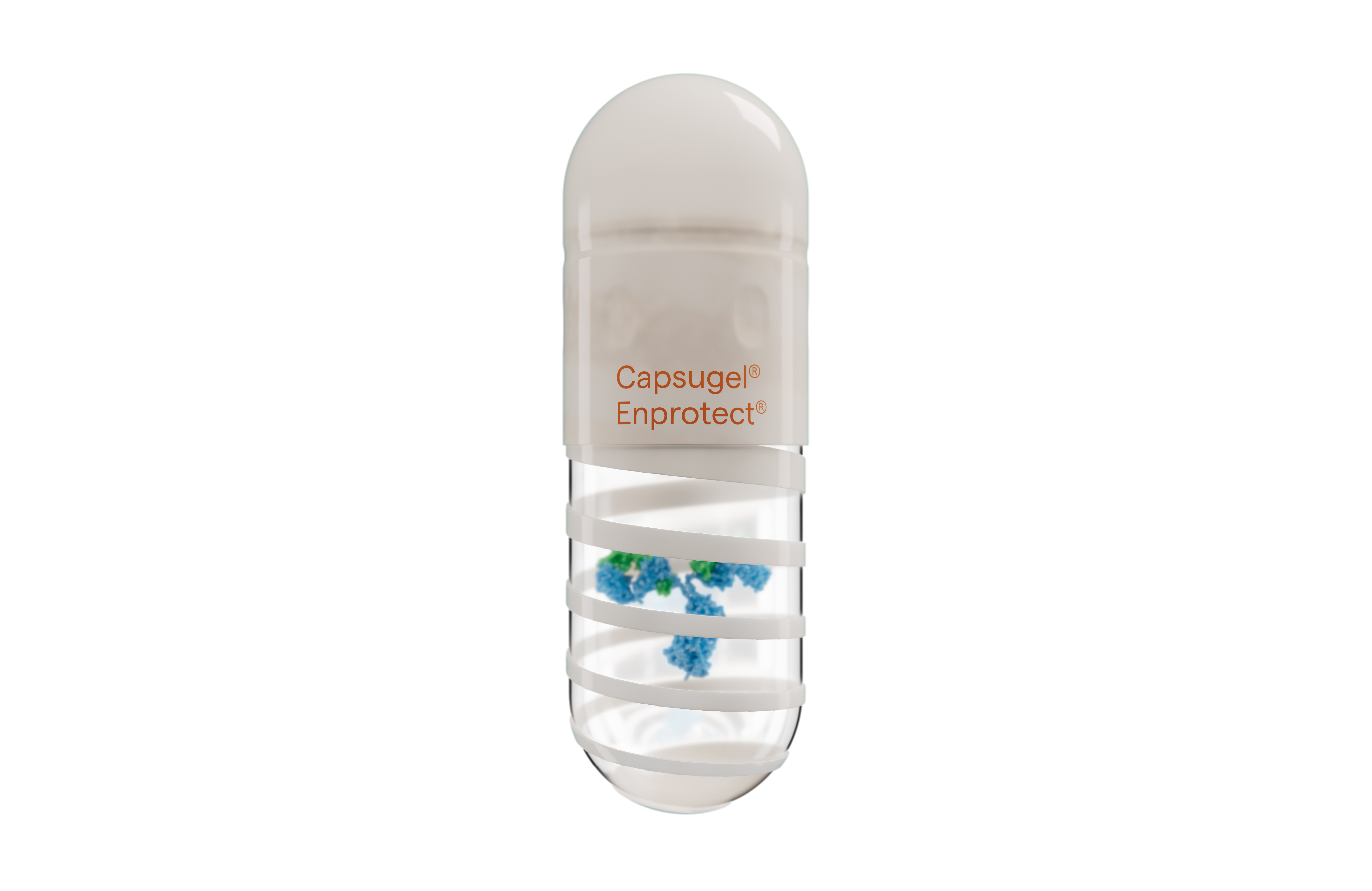
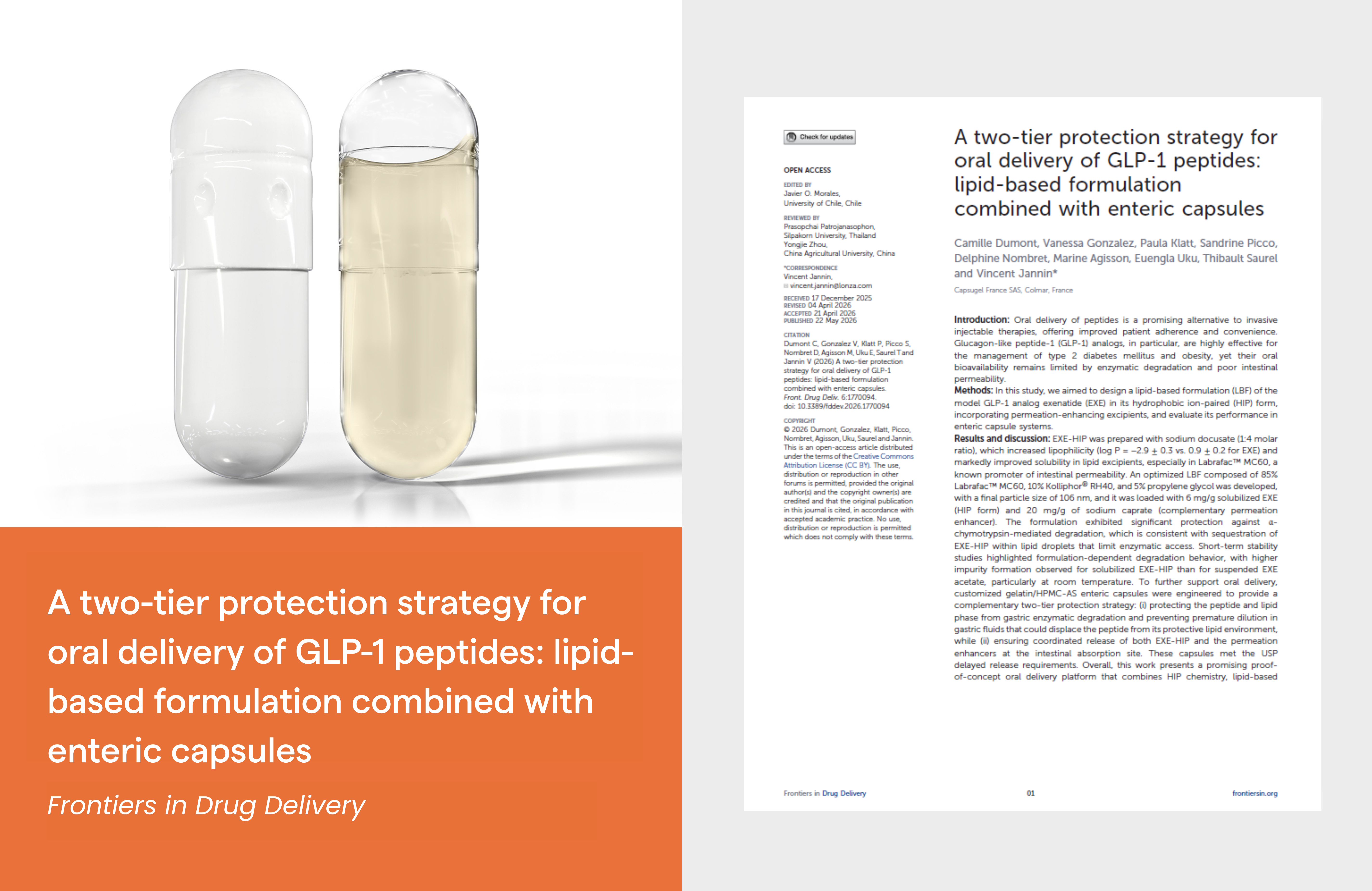
Strategies to support oral biologic delivery intended for systemic distribution can include ways to increase absorption, such as permeation enhancers (such as sodium caprylate or SNAC), which act on the cell barrier, or lipid-based formulations (LBFs), which support absorption of drugs by allowing them to pass through the lipid bi-layer.7,20,21 Capsugel recently demonstrated a scalable model for oral delivery of the GLP-1 RA exenatide.15 This model was designed to increase bioavailability through hydrophobic ion pairs (HIPs), LBFs, and permeation enhancers combined with a compatible ready-to-use enteric capsule.15
Conclusion
Innovation in oral formulation technologies has opened new avenues for the lifecycle management and patent protection of biologics. Technologies such as SNAC, LBFs, HIPs, permeation enhancers, and Capsugel® Enprotect® capsules are now enabling the oral delivery of biologics. This step forward has the potential to benefit patients (with increased choice and accessibility), the healthcare system (with reduced staff workload and waste), and pharmaceutical companies (with extended patent protections).
To learn more, contact our Lonza Capsugel experts today. Contact Us | Lonza
References
- Jones G, et al. Strategies that delay or prevent the timely availability of affordable generic drugs in the United States. Blood. 2016;127(11):1398–1402.
- Drug Patent Watch. How to Own a Market you Don’t Own: Market Access Strategies Post-Drug Patent Expiration. Available at: https://www.drugpatentwatch.com/blog/how-to-own-a-market-you-dont-own-market-access-strategies-post-patent-expiration/#:~:text=II.&text=Lifecycle%20management%20(LCM)%20is%20the,later%20reimbursement%20of%20improved%20formulations. Accessed May 2026.
- Drug Patent Watch. The Patent Playbook: 7 Key Strategies Pharma Uses to Extend Market Exclusivity. Available at: https://www.drugpatentwatch.com/blog/the-patent-playbook-7-key-strategies-pharma-uses-to-extend-market-exclusivity/#:~:text=Old%20Drugs%2C%20New%20Tricks,already%20approved%20for%20other%20conditions.&text=A%20company%20can%20then%20secure,to%20treat%20the%20new%20disease.&text=This%20approach%20offers%20significant%20advantages,new%20chemical%20entity%20from%20scratch.&text=This%20makes%20it%20a%20particularly,might%20otherwise%20be%20commercially%20unviable. Accessed May 2026.
- Spruhill M, et al. Strategies for Extending the Life of Patents. BioPharm International. Available at: https://www.alston.com/-/media/files/insights/publications/2005/05/strategies-for-extending-the-life-of-patents/files/biopharm-spruill-may2005/fileattachment/biopharm-spruill-may2005.pdf Accessed May 2026.
- Drug Patent Watch. What Happens When a Drug Patent Expires? Understanding Drug Patent Life. Available at: https://www.drugpatentwatch.com/blog/what-happens-when-a-drug-patent-expires/#:~:text=Strategy%201:%20Authorized%20Generics,run%20competitive%20outcomes%20%5B19%5D. Accessed May 2026.
- Drug Patent Watch. Maximizing GLP-1 Market Exclusivity: Leveraging Patent Term Extension (PTE) and NCE Exclusivity to Protect Blockbuster Status. Available at: https://www.drugpatentwatch.com/blog/maximizing-glp-1-market-exclusivity-leveraging-patent-term-extension-pte-and-nce-exclusivity-to-protect-blockbuster-status/#:~:text=Enabling%20the%20Oral%20Frontier:%20The,caprylate%2C%20better%20known%20as%20SNAC.&text=The%20IP%20strategy%20for%20Rybelsus%20extends%20far%20beyond%20the%20core,stearate%20required%20for%20optimal%20absorption.&text=Key%20patents%20such%20as%20US,protected%20for%20nearly%20another%20decade.&text=However%2C%20this%20strategy%20is%20not,the%20still%2Dpatented%20oral%20formulation. Accessed May 2026.
- Chubb B, et al. PDB25 The cost-effectiveness of ORAL semaglutide in patients treated with currently available GLP-1 receptor agonists - A UK perspective. Value in Health. 2020;23(S2):S509.
- Elnaggar M, et al. The long-term cost-effectiveness of oral semaglutide versus lower-cost liraglutide in the UK. Diabetes Ther. 2025;16(4):613–628.
- Aroda V, et al. A new era for oral peptides: SNAC and the development of oral semaglutide for the treatment of type 2 diabetes. Rev Endocr Metab Disord. 2022;23(5):979–994.
- Myers J, et al. Preference for novel alternative to parenterally administered medications. Patient Pref Adher. 2024;18:1547–1562.
- Igarashi A, et al. Preference for oral and injectable GLP-1 RA therapy profiles in Japanese patients with type 2 diabetes: A discrete choice experiment. Adv Ther. 2020;38(1):721–738.
- Grand View Horizon. Rybelsus (oral Semaglutide) - Semaglutide Market Statistics. Available at: https://www.grandviewresearch.com/horizon/statistics/semaglutide-market/product/rybelsus-oral-semaglutide/global. Accessed May 2026.
- Palacios JI, et al. High-velocity delivery of biologics via the gastrointestinal tract by self-pressurized oral capsules. J Controlled Release. 2025;385:113963.
- Lau BD, et al. Budget impact analysis of conversion from intravenous to oral medication when clinically eligible for oral intake. Clin Ther. 2011;33:1792–1796.
- Dumont C, et al. Improving oral bioavailability of therapeutics peptides with lipid-based formulations and ready-to-use customized enteric capsules. AAPS PharmSci 360 Annual Meeting. 9–12 November 2025, San Antonio, TX. Poster M1230-06-38.
- Grimm M, et al. In vivo evaluation of a gastro-resistant Enprotect® capsule under postprandial conditions. Pharmaceutics. 2023;15(11):2576. doi: 10.3390/pharmaceutics15112576.
- Jannin V, et al. In vitro evaluation of the gastrointestinal delivery of acid-sensitive pancrelipase in a next generation enteric capsule using an exocrine pancreatic insufficiency disease model. Int J Pharm. 2023:630:122441. doi: 10.1016/j.ijpharm.2022.122441.
- Jannin V, et al. Enteric properties of Capsugel® Enprotect® capsules filled with Fecal Microbiota Transplant are confirmed after 12-month storage at -80°C. ECP 2025. 24–25 March 2025, Porto, Portugal. Poster Presentation.
- Bakken J, et al. Treating Clostridium difficile Infection with Fecal Microbiota Transplantation. Clin Gastroenterol Hepatol. 2011;9(12):1044–1049.
- Masloh S, et al. Challenges and opportunities in the oral delivery of recombinant biologics pharmaceutics. 2023;15(5):1415. doi: 10.3390/pharmaceutics15051415.
- Hashmi AR, et al. Advanced drug delivery strategies to overcome solubility and permeability challenges: Driving biopharmaceutical advancements toward commercial success. ACS Omega. 2025;10(36):40769–40792.
Related Content
Latest CHI content